The full implementation of the MiCA (Markets in Crypto-Assets) framework across Europe and the intensification of the SEC’s “Travel Rule” in the US have fundamentally altered the landscape of digital asset ownership. By 2026, the “surveillance-state” approach to finance has reached the blockchain. Every centralized exchange is now required to report not just your trades, but the “source of wealth” for every deposit you make. For investors who still believe in the original cypherpunk ethos of crypto, finding the Finest way to purchase Monero No KYC is not about avoiding rules, it’s about Strategic Data Protection.
The Shift Toward Self-Custody Solutions ⛓️
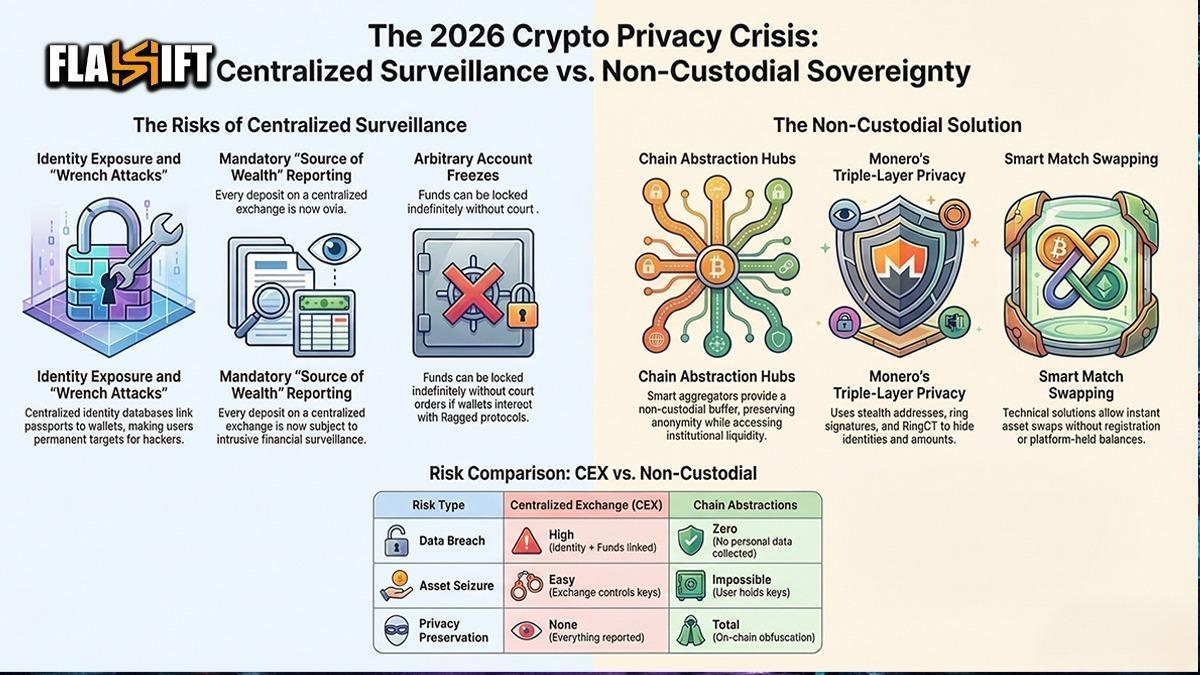
For years, traders believed that as long as they weren’t doing anything illegal, KYC was a harmless inconvenience. 2026 has proven otherwise. Centralized “Identity Databases” have become the primary target for state-sponsored hackers and malicious actors. When an exchange links your passport to your wallet address, that data is stored on servers that have proven to be susceptible to breaches. Once your identity is leaked alongside your crypto balance, you become a permanent target for phishing, physical extortion, and “wrench attacks.”
The regulatory environment has also introduced “Account Freezes” as a standard compliance tool. If your wallet has ever interacted—even indirectly—with a “flagged” protocol or a mixer, your funds on a centralized exchange can be locked indefinitely without a court order. This is why smart chain abstractions like Flashift has emerged as the essential hub for 2026: it provides a non-custodial buffer that preserves your anonymity while giving you access to institutional-grade liquidity.
Monero (XMR): The Last Fortress of Anonymity
While Bitcoin and Ethereum offer transparency that regulators love, Monero remains the only battle-tested asset that protects the user by default. Unlike “Privacy Tunnels” or external mixers that can be blacklisted by chain analysis software, Monero’s privacy features are baked into its base layer:
- Stealth Addresses: Every transaction uses a unique, one-time address, making it impossible to link a user’s wallet to their on-chain activity.
- Ring Signatures: The sender’s identity is mixed with a group of other users, creating a mathematical “shroud” that chain analysis tools cannot pierce.
- RingCT (Ring Confidential Transactions): This feature hides the transaction amount, preventing observers from seeing how much wealth is being moved in real-time.
In a market defined by over-regulation, Flashift serves as a simple but smart chain abstraction for users who refuse to compromise on security or efficiency. By providing AI recommendations, it offers a purely technical solution for asset exchange:
- Offer Best Market Rates: Real-time scanning of 50+ liquidity providers.
- No Account Creation Required: Complete anonymity with zero registration.
- Support for All Private Assets: Seamless swaps across multiple blockchains.
- Non-Custodial Architecture: Total control over your private keys at all times.
- Instant Swap: No delays or platform-held balances.
The Risk Matrix of Centralized Surveillance
|
Risk Type |
Centralized Exchange (CEX) |
Chain Abstractions |
|
Data Breach |
High (Identity + Funds linked) |
Zero (No personal data collected) |
|
Asset Seizure |
Easy (Exchange controls keys) |
Impossible (User holds keys) |
|
Regulatory Freeze |
High (MiCA/Travel Rule compliance) |
Low (Non-custodial routing) |
|
Privacy Preservation |
None (Everything reported) |
Total (On-chain obfuscation) |
Why Chain Abstractions Are the Best Secure Gateway
Because of extreme regulatory pressure, most mainstream exchanges have delisted Monero, forcing users into risky, low-volume P2P markets. However, high-level investors cannot afford the risk of a P2P scam or a “dirty” transaction. Chain abstractions bridge this gap. By connecting to dozens of smaller, private liquidity providers, these smart aggregators allows a user to swap common assets like USDT or BTC into privacy tokens like monero instantly and safely.
The process is designed for 2026 speeds: simply select your pair, let the Smart Match engine find the provider with the best price and lowest risk of interference, and receive your XMR directly to your private, non-custodial wallet, not a platform account.
The Future of Financial Sovereignty
In 2026, privacy is no longer about hiding; it is about protecting. Protecting your data from hackers, protecting your assets from arbitrary freezes, and protecting your freedom from overreaching surveillance. By moving your portfolio into privacy-centric assets through a non-custodial aggregator, you are reclaiming the sovereignty that the traditional financial system is trying to take away.
About Author