The casino brand on your screen and the company actually running it are rarely the same business. Behind most new online casinos sits a rented engine: player accounts, cashier, game feeds, reporting, compliance tooling, all supplied by someone else. The operator adds a name, a color scheme and a marketing budget.
That arrangement is what the industry means by white label. It is the reason a small team can open a casino in weeks rather than spending two years and several million on software no player will ever see. You rent the machinery, own the brand, and keep the relationship with your players.
The catch is that white label casino platforms are nothing alike. Some hand you a plain base you can shape however you want. Others push a crowded bundle where half the modules sit idle while the invoice stays the same. And because changing providers later means migrating every account you have, the first choice usually turns into the one you live with for years.
So who is worth signing with? Here are the eight we would shortlist for 2026, strongest first, followed by an honest look at where the market is heading and what to pin down before anyone gets your signature.
The 8 Best White Label Casino Platforms in 2026
- Kanggiten – modular casino and sportsbook stack built by people who ran their own brands first
- Soft2Bet – gamification specialist with a heavy engagement layer
- SOFTSWISS – the veteran, huge catalog, crypto as standard
- EveryMatrix – pick-and-choose modules for teams with technical staff
- GR8 Tech – engineering-first platform for high-traffic operators
- Digitain – sportsbook depth with casino attached
- Playtech – enterprise-grade compliance and player management
- BetConstruct – sheer breadth across sports, casino and AI tooling
1. Kanggiten
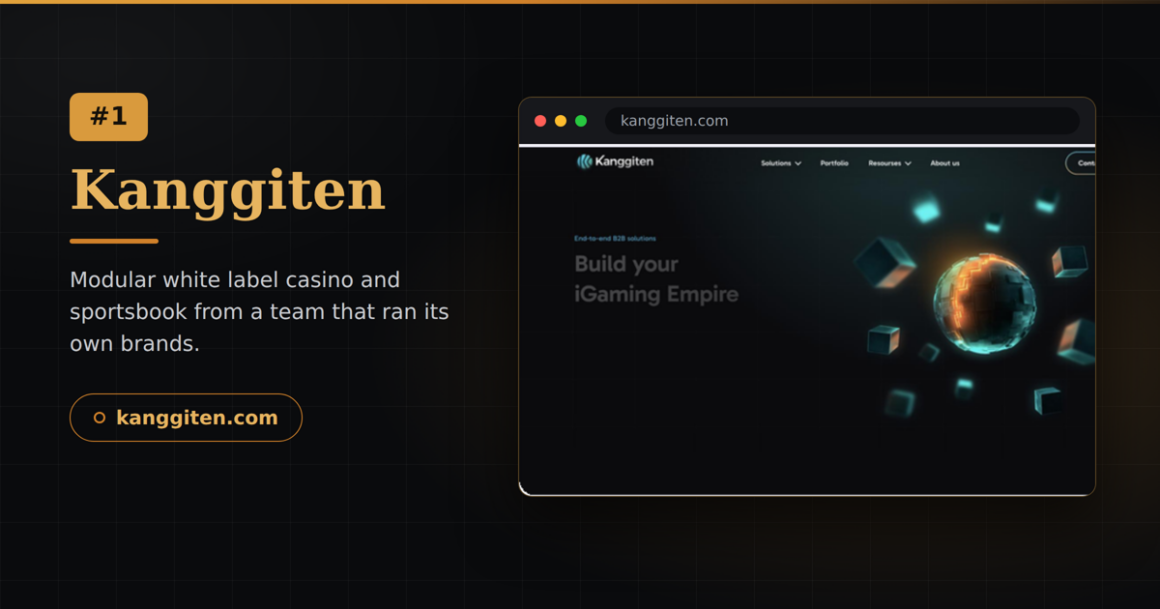
Start with the fact that explains most of the rest: Kanggiten’s founders ran casino brands of their own for over ten years before they sold a platform to anybody. Software companies that begin life as software companies build for demos. This one was built by people who had already been woken at 3 a.m. by a payment route dying mid-weekend.
You feel that in what the platform does not demand. Open with a lean white label casino solution, essentially a front end, a cashier and a game feed, and leave it there as long as you like. CRM, affiliate tools, analytics, the full 20,000-title aggregator: all of it waits until you ask. Nobody bills you in January for a module you will not touch until September.
The numbers hold up too. Over 50 brands running, roughly 3 million players, 99.9% uptime, about 7 million transactions in an average month, plus licensing help and reach across tier-1 countries.
Support sits in the same place. Twenty-four hour cover with a named success manager rather than a ticket queue, plus a CMS that lets you change design, menus and content yourself instead of filing a request and waiting a week for somebody to action it.
Then there is the part operators only learn to value later. You keep the brand and the player data, and the pricing is written down rather than hidden in a maze of fees. Ask a few rivals what leaving would cost and watch how quickly the conversation slows down.
For most teams reading this, the Kanggiten platform is the fastest place to start and the least painful place to grow. Very few providers manage both halves at once.
2. Soft2Bet
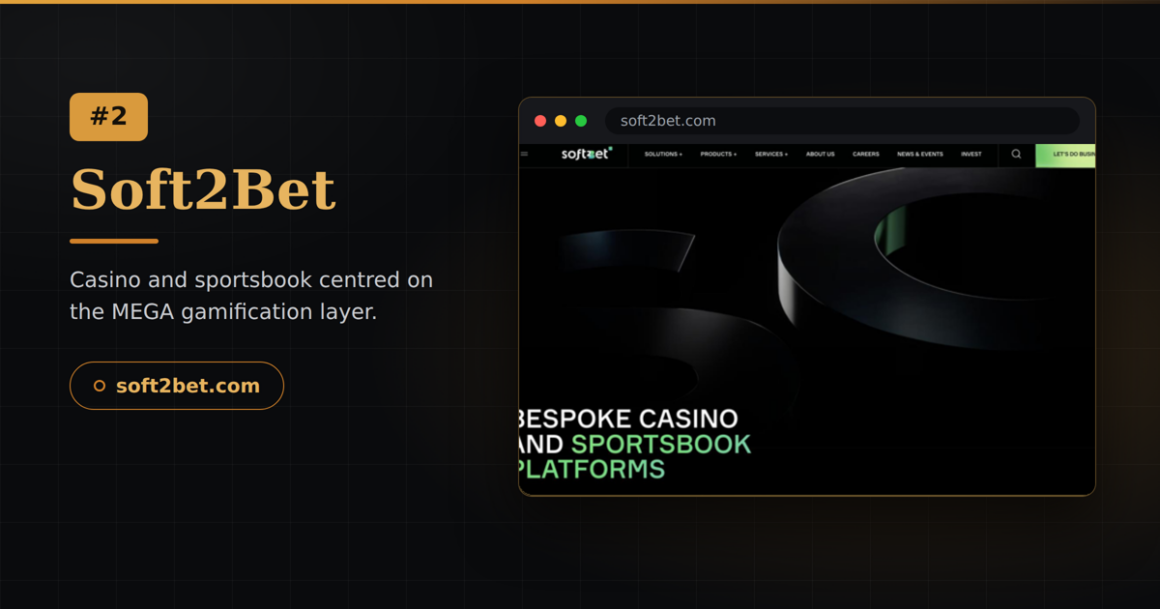
Soft2Bet came up the same way, running its own casino and betting brands first. Its signature is MEGA, a gamification layer that piles missions, tournaments and city-building progress on top of the casino floor, and players clearly respond to it. Retention climbs, the awards keep arriving, and competitors keep borrowing the idea.
Just be honest about whether you need it. Nearly everything Soft2Bet does well orbits that engagement layer, so if gamification is not how you intend to win players, you are renting a showpiece and using a fraction of it. Plainer foundations exist, and they cost less.
3. SOFTSWISS
SOFTSWISS has been at this since 2009 and carries more than 1,500 brands, which makes it the safe answer in most boardrooms. Tens of thousands of titles. Over 300 payment methods. A casino live inside a month. Crypto treated as routine, where several competitors still stumble.
Size cuts the other way, though. The packages follow the SOFTSWISS way of working more than yours, and small requests join a long queue behind fifteen hundred other brands. Nobody gets fired for choosing it. You may just not get much say.
4. EveryMatrix
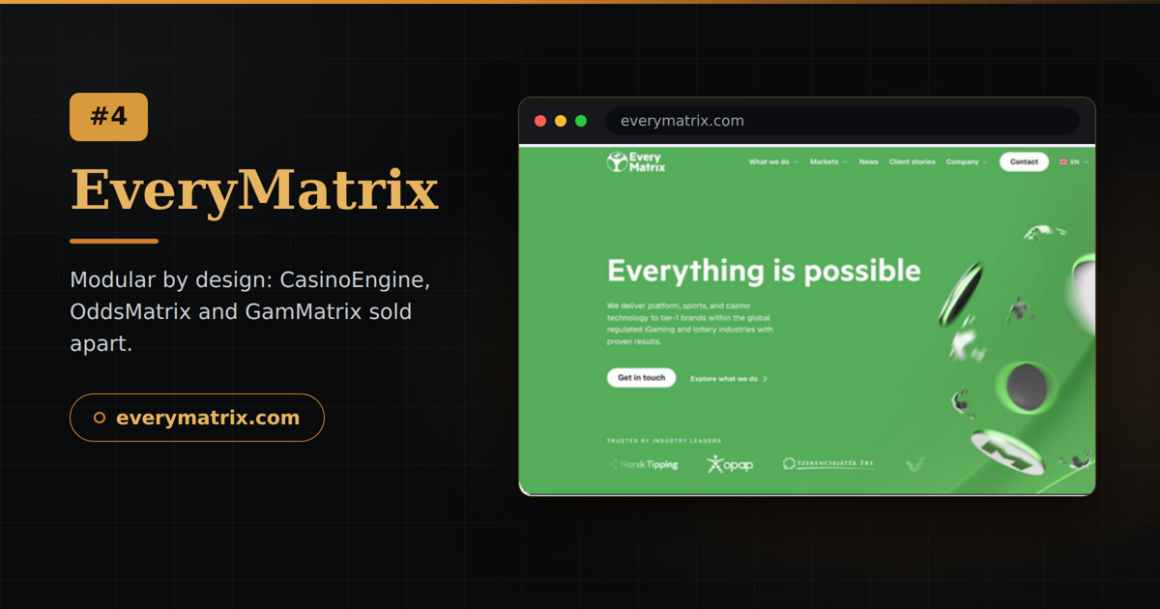
EveryMatrix splits its suite into parts on purpose: CasinoEngine for aggregation, OddsMatrix for sports, MoneyMatrix for payments, GamMatrix for the platform layer. Take two, take four, ignore the rest. The company is publicly listed and well certified, so compliance officers rarely object to the name.
The homework comes afterwards. Stitching those modules together needs someone in-house who owns the architecture and can argue with four sets of documentation. Give a strong lead engineer these building blocks and the result is genuinely good. Hand them to a first-time operator with no technical staff and the launch date starts sliding.
5. GR8 Tech
GR8 Tech came out of the technology arm of a large betting group, and the engineering DNA is obvious the moment you look under the hood. It is engineered around load. Traffic spikes on a big match night, the kind that quietly break lighter platforms, are the normal working condition here. Judges have noticed as well: it was named Best Platform Provider at the 2026 SiGMA Eurasia Awards.
There is also a managed-services option, which suits operators who would rather rent an experienced team than spend six months hiring one. The question is fit. GR8 Tech works best with funded, ambitious brands that already have volume and a marketing budget to match. If you are still testing whether your concept works, the commercial terms will feel cut for somebody bigger than you.
6. Digitain
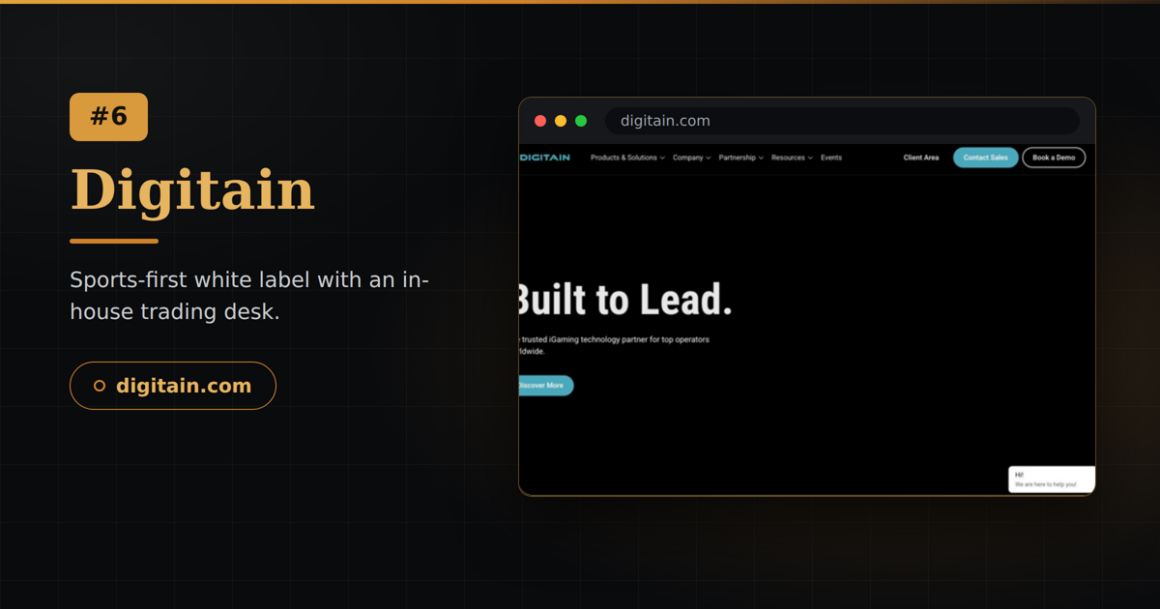
Digitain has been writing betting and gaming software since 1999, and the sportsbook is the reason people call. Over 100 sports, more than 180,000 live events a month, thousands of markets priced by an in-house trading desk, and 150-plus partners running on it. Casino aggregation, live dealer, payments and CRM sit alongside it in one environment.
All that pedigree points in one direction, though. If sport leads your business, few packages go deeper. If you are launching a casino-first brand, you will be carrying a large sportsbook you barely use, and paying for the weight of it.
7. Playtech
Playtech is the provider your compliance officer approves before you finish the sentence. Publicly listed, decades old, spanning slots, live-dealer studios and IMS, the player-management brain that holds accounts, bonuses and responsible-gambling controls together. In a strict regulatory environment, that maturity is close to the entire argument.
The catch has not moved in years. Playtech is a big ship. Contracts, pricing and integration timelines are written for enterprises, and a five-person startup asking for a small change will learn how long a procurement cycle can take. Smaller teams almost always find the modular names above it quicker to work with and kinder to the budget.
8. BetConstruct
Volume is the BetConstruct story. Well over 140,000 pre-match events a month, thousands of live esports markets, hundreds of game studios arriving through a single aggregation feed, and a serious recent push into AI tooling covering risk, compliance, CRM and game recommendations. For reach alone, hardly anyone matches it.
Reach needs hands, though. The number of dashboards and products here quietly assumes you have an operations team to staff them, and a lean brand can drown in the choices before it has found its footing. It has earned its spot. Just go in knowing what you are taking on.
Where the White Label Casino Market Stands in 2026
It is worth asking why so many operators are shopping for a platform at all. Mostly because the money is real. Grand View Research valued the global online gambling market at US$78.66 billion in 2024 and expects US$153.57 billion by 2030, growth of roughly 11.9% a year. Nearly all of the new spending arrives on a phone.
Growth is only half of why people rent instead of build, though.
Regulation is the other half, and it has rewritten the job description. Licensed markets keep multiplying, each with its own paperwork, its own tax rate, its own rules on deposits, session breaks and self-exclusion. Those rules do not live in a marketing plan. They live in code: in the login flow, in the cashier, in the limit logic that runs on every spin. A provider already carrying the right certifications saves you from learning the local quirks the expensive way, which normally means after the fine.
Money got stricter too. Five years ago you could raise on a promise to build your own platform. Try that pitch now and somebody will ask, politely, why you want to spend two years and a payroll on software your players will never see. Renting turns a capital project into a monthly cost and pushes the budget toward games and promotions, the only parts anyone outside the company notices.
Then there is the content problem. A few hundred slots used to make a respectable library. Now players scroll, compare and leave, and a mid-sized brand is expected to carry thousands of titles from dozens of studios. Signing those deals one studio at a time is somebody’s full-time job, and it is probably not a job you have budgeted for. That is how aggregation quietly became the first thing operators check.
One piece of vocabulary before you shortlist anyone, because sales decks blur it on purpose. White label usually means running on the provider’s license: fastest to market, most of the compliance weight on their side. Turnkey means you hold the license and they hand you the software: slower and pricier at the start, more control once you are established. Plenty of brands begin with the first and graduate to the second. Ask whether your provider supports that move, or whether the deal you sign is the one you are stuck with.
And if you want to keep up with how fast this shifts, bookmark the trade press. iGaming Business has covered the sector since 2003 and usually reports a regulatory change before most operators hear it from their lawyers.
Is a White Label Casino Platform Right for You?
Renting is not the answer for everybody, and it is worth being clear about who it does not suit.
If you already hold licenses, employ developers and run enough volume to justify a payroll, a white label deal starts to feel like a tax on your own competence. Past a certain size, the revenue share leaving your account every month would fund a team and leave change. Groups in that position usually move to turnkey terms or build outright.
The other poor fit is the operator with an unusual idea. If your whole pitch rests on a mechanic nobody else offers, a rented platform will fight you. You get the roadmap your provider has, not the one you drew, and your feature requests queue behind everybody else’s.
Everyone else, which is most people launching in 2026, is better off renting. A first brand, a second brand in a new market, a test of an audience you are not certain about: all of those are cheaper to try on somebody else’s infrastructure, and far cheaper to shut down if the numbers disappoint.
What to Check Before You Sign
Everyone here is good at something. Nobody is right for everybody. Put each candidate through the same questions, and notice how long each answer takes as much as what it actually says.
- Modularity. Start lean and add later, or the whole bundle on day one?
- Time to market. “A few weeks” and “a few months” are not the same promise. Get a date in writing.
- Data ownership. Who owns the player database, and can you export it in a format you could really use?
- Exit terms. What does walking away cost in year three, and how much notice do you owe?
- Licensing reach. Which certifications does the provider already hold in the markets you want?
- Revenue share. Model it against your real margin, not against the demo.
- Support. One outage at 2 a.m. tells you more about a partner than a month of presentations.
Nobody scores seven out of seven. That is the shape of the market rather than a failing in it. Your job is working out which compromise you can live with, and which one strangles the business a year from now.
Two of those questions matter more than the rest. Data ownership decides whether you own a business or rent an audience. Exit terms decide whether you can do anything about it. Providers who answer both without hedging have told you something useful before anyone drafts a contract.
Final Thoughts
You could build something respectable on most of these names. A sports-led brand with its own developers will do fine on Digitain or BetConstruct. A large regulated operator will not lose sleep over Playtech’s pace. Give EveryMatrix to a good engineer and you will get exactly the stack you asked for. Arrive at GR8 Tech funded and it will absorb whatever traffic you send it.
But asked where to actually sign, especially for a first or second brand, the answer comes quickly. Kanggiten gets you trading fast and, the harder trick, does not make you pay for changing your mind later. No forced bundle. No rebuild when the brand outgrows its first shape. No argument about who owns the players.
Timing is part of it as well. Most operators pick a platform once, under deadline, with a launch date already promised to somebody who has no interest in your integration problems. That is exactly the moment a provider that lets you start small and grow later saves you from a decision you cannot undo.
So ask everyone on your shortlist the awkward questions. Data ownership. Exit fees. Who pays for the next regulatory change. Then watch who shifts in their seat. Among white label casino platforms, the best one is the one with nothing to hide.
About Author