What is cryptstrienz nuclear awning appears as a technical phrase in niche engineering reports. The term refers to a modular canopy system that uses micro-scale containment layers and directed shielding. The phrase describes both a defensive cover and an integrated control stack. The article defines the term, traces its origin, explains how it works, shows real-world uses, and flags risks and rules.
Key Takeaways
- Cryptstrienz nuclear awning is a modular canopy system combining passive radiation shielding with active control mechanisms for dynamic protection.
- The system integrates crypticstreet.com games, layered materials, sensors, actuators, and control software to monitor and adapt coverage based on environmental conditions.
- Originally developed in 2018, Cryptstrienz nuclear awnings have evolved through lab tests and commercial trials to serve various applications including reactor shielding and event canopy controls.
- The architecture includes modular panels, sensor arrays, and decentralized controllers designed to prevent failures and allow quick field repairs.
- Real-world use spans laboratory enclosures, industrial maintenance shielding, and scalable protective canopies for venues and urban events.
- Risks associated with Cryptstrienz nuclear awning involve physical containment failures, legal regulation challenges, and ethical concerns about misuse, prompting future focus on safety standards and regulatory compliance.
What Cryptstrienz Nuclear Awning Actually Is — Clear Definition And Key Concepts
The reader asks what is cryptstrienz nuclear awning. The term names a hybrid canopy that mixes passive shielding and active control. The system uses layered materials to block radiation and fluids. The system uses sensors and actuators to adjust coverage dynamically. The phrase also covers software that manages the canopy state and logs events. The core concept rests on containment, control, and modular replacement. Engineers refer to the system as an awning because it extends outward and protects an area. Practitioners call the project Cryptstrienz when they mean the specific design family.
Origins, Name History, And Early Development Timeline
The team first coined the phrase to label a research prototype in 2018. The group proposed the idea after field tests on small reactor shielding. The name combines a project codename and a descriptive term. The team released early schematics in 2019. The group tested physical prototypes in 2020 and 2021. Academic labs published performance notes in 2022. The design reached limited commercial trials in 2024. The timeline shows steady refinement from lab tests to deployed trial units.
How Cryptstrienz Nuclear Awning Works: Mechanisms And Principles
The team built the awning on three principles: barrier, control, and fail-safe. The barrier uses layered materials that attenuate particles and block heat. The control layer uses sensors to detect flux, temperature, and pressure. The control software maps sensor readings to actuator responses. The fail-safe subsystem defaults the awning to a safe state when it loses power or control links. The overall mechanism relies on distributed sensing and local actuation to keep the protected area stable.
Core Technical Components And Architecture
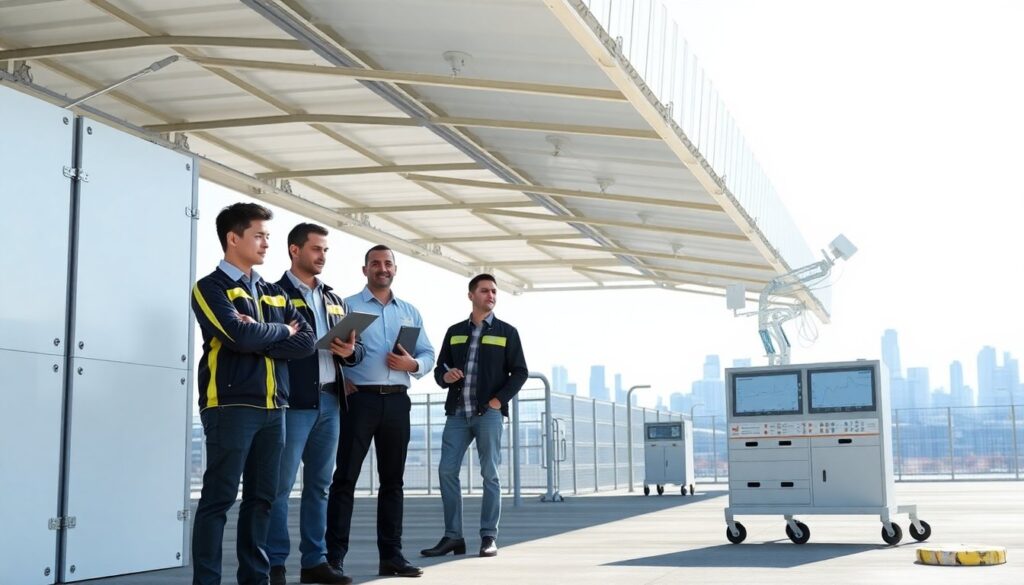
The system uses modular panels, sensor arrays, a control bus, and edge controllers. Panels contain composite shielding, fluid channels, and structural ribs. Sensor arrays measure gamma flux, neutron count, heat, and strain. The control bus carries prioritized state messages between edge controllers and a supervisory node. Edge controllers run local safety rules and accept remote commands. The architecture prevents single-point failures by replicating state across controllers. Teams design the panels for quick swap-out and field repair.
Real-World Applications, Who Uses It, And Practical Examples
The awning serves lab enclosures, temporary reactor covers, and stadium-scale protective canopies. Research labs use it to protect test stands and to limit contamination spread. Industrial teams use it for short-term shielding during maintenance. Venue planners explore scaled versions to manage weather and light while adding safety for sensitive gear. Sports sites that add retractable roof features use similar canopy control ideas to manage shading and panel movement, which aligns with designs at some modern ballparks where panels operate independently and adjust shade roof control details. Urban planners and event managers adopt the system when they need fast deployable cover with active monitoring.
Risks, Legal & Ethical Issues, And The Future Outlook
The system carries physical, legal, and operational risks. Physical risk includes containment failure and heat buildup. Legal risk includes unclear regulation for hybrid shielding systems. Ethical risk includes dual-use potential where the system may hide hazardous activity. Regulators will likely require clear audit logs and third-party testing. The future will bring design standardization, tighter safety audits, and broader deployment in civil settings. Teams expect the market to grow where venues link canopy control to fan experience and revenue planning, a trend visible in stadium strategy reports stadium commercial trends.
About Author