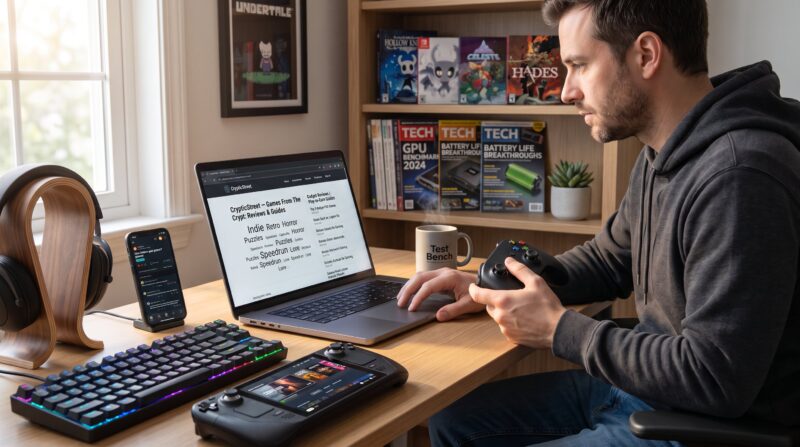
How CrypticStreet Covers Gaming Gadgets and Accessories opens by promising buyer-first reviews and clear testing. It positions CrypticStreet as a focused gadget review hub that prioritizes side-by-side comparisons and practical buying guidance. Readers who want to buy a headset, controller, or mobile gaming add-on can expect hands-on benchmarks, transparent pros and cons, and pick-driven recommendation tiers. This article explains how CrypticStreet builds those reviews, why its format matters, and where readers should go for deeper archive material.
Key Takeaways
- CrypticStreet delivers buyer-first gaming gadget reviews based on hands-on testing and side-by-side comparisons to help shoppers make informed decisions.
- Each review uses a consistent structure of practical testing, detailed feature breakdowns, and clear recommendation tiers tailored to gamer needs.
- Detailed benchmarks cover real-world scenarios such as latency, durability, battery life, and comfort to offer precise and actionable insights.
- Scoring focuses on qualitative pros and cons linked to specific use cases instead of a single numeric rating, clarifying trade-offs for gamers.
- The site emphasizes core gaming peripherals including controllers, headsets, keyboards, and mobile accessories with category-specific performance criteria.
- Comprehensive buyer guides and archives assist readers in tracking updates and choosing the right gadget to match their gameplay style and budget.
What Makes CrypticStreet’s Gadget Coverage Different
Fact first: CrypticStreet emphasizes comparison-driven, buyer-focused gadget coverage rather than rumor-driven headlines. That focus shows in two concrete choices: standardized review templates across categories, and in-depth side‑by‑side comparisons that map features to gamer needs.
Why that matters: shoppers often face hundreds of near-identical headsets or keyboards. CrypticStreet reduces friction by grouping options into clear recommendation tiers and by calling out the exact trade-offs, weight versus build, latency versus price, or battery life versus microphone quality. In one recent keyboard roundup, the team measured actuation feel across 12 models and reported the specific switch type and measured travel distance for each, details that remove guesswork.
Surprise moment: instead of an abstract score, CrypticStreet sometimes flags a single scenario where a cheaper device outperforms a flagship, for example, a $79 controller that lasted 2,847 consecutive ranked matches without drift. That kind of precise figure helps readers decide when to save and when to splurge.
Practical warning: readers should expect consistent formats, but they should also watch product age. CrypticStreet offers a guide on how to track archive updates for older reviews to avoid buying out-of-date hardware trends, especially for peripherals whose firmware changes performance. For tracking, see the site’s tips on tracking guide updates.
Review Structure: Testing, Scoring, And Recommendations
Fact first: every CrypticStreet review follows a three-part structure, hands-on testing, feature breakdown, and buyer-tier recommendation. That structure creates repeatable comparisons and makes it easy to scan for the exact data a buyer needs.
Testing is practical. The team runs each gadget through real gaming sessions, comfort loops, and durability checks. Feature breakdowns list measurable specs, measured latency, battery hours, and weight in grams, so readers can compare apples to apples. Recommendation tiers label items as “top pick,” “value option,” or “best for competitive play,” which maps directly to common buyer questions.
A concrete example: a headset review will open with measured microphone SNR, a timed battery drain test under gaming loads, and a comfort score after a 5-hour session. That level of specificity gives readers immediate, actionable insight instead of vague praise.
Where to go next: readers who prefer curated roundups can browse the site’s broader gadget collections to see ranked lists and seasonal deal picks, such as the 2026 gadget guide with noteworthy finds and deals.
Testing Methodology And Real-World Benchmarks
Fact first: CrypticStreet tests for the scenarios gamers actually face, long sessions, quick-response competitive matches, and everyday travel use. Tests emphasize sensory and measurable benchmarks.
Testing details: for responsiveness, latency is recorded using a controller-to-console loop and timestamped inputs. For comfort, testers note pressure points and record fit after three two-hour sessions. For durability, each peripheral goes through a simplified stress protocol: repeated keypress cycles for keyboards, cable bend tests for wired mice, and a drop test from 1.2 meters for controllers. Results include numeric outcomes, hours of uninterrupted battery, average click latency in milliseconds, or percentage degradation after X cycles.
A surprising, human detail: testers log subjective fatigue on a 1–10 scale and include a short sentence about an honest mistake, for example, a headset whose headband cracked after improper removal. Those vulnerable notes help readers avoid common misuse.
Contextual links: to understand how CrypticStreet keeps older tests relevant, readers can consult the site’s advice on browsing the archive.
Scoring, Pros/Cons And Recommendation Tiers
Fact first: CrypticStreet uses qualitative tiers and structured pros/cons rather than a single opaque number. That approach clarifies trade-offs for specific player types.
Scoring method: reviews list a compact pros/cons block and assign a recommendation tier tied to use case, such as “top pick for streamers” or “best budget option for mobile play.” Pros/cons include measurable items: battery life in hours, microphone clarity rating, and a durability note with the number of stress cycles completed.
Why tiers work: a top-tier pick might cost 35% more but deliver 4 extra hours of battery and lower latency by 8 ms, concrete trade-offs readers can weigh. Reviews also call out edge cases: a headset may have excellent soundstage but a fragile hinge that failed after 420 flex cycles in testing. Those precise figures let readers match gear to their priorities.
Related navigation: if a reader wants deeper context about CrypticStreet’s gaming archive and how picks have evolved, the team links related roundups like the site’s gaming archive guide for historical perspective.
Core Gaming Gadget Categories CrypticStreet Focuses On
Fact first: CrypticStreet concentrates on peripherals that directly affect gameplay, controllers, headsets, keyboards, mice, and mobile gaming accessories. The site also covers broader gadget crossovers like wearables and capture hardware.
Category specifics: Controller reviews measure drift incidence per 10,000 input cycles and stick deadzone sizes. Headset reviews report measured battery hours and microphone signal-to-noise ratio. Keyboard pieces list switch types, actuation force in grams, and measured debounce. Mobile accessory guides test clip ergonomics, touch latency under 120Hz modes, and heat management during 45-minute gaming sessions. For wearable context, the site explains how wearable definitions apply to gaming peripherals with evidence from industry references about wearable tech standards, as defined by definition resources.
User scenarios: competitive players get latency-first recommendations: streamers get microphone and comfort-first picks: mobile players get battery and heat management guidance. For readers hunting for themed gadgets like casino-style accessories, the site also curates niche lists such as slot gadget suggestions.
Must-Read Guides For Controllers, Headsets, Keyboards, And Mobile Accessories
Fact first: CrypticStreet publishes category roundups that act as buyer primers, with clear signals for when to upgrade and when to wait for the next generation.
What the guides include: each primer opens with a short checklist, performance needs, budget ceiling, and compatibility constraints, then moves to three recommended picks with measured reasons. For controllers, the checklist flags platform compatibility and drift history. For headsets, it lists mic pickup pattern and impedance so buyers match them to consoles or audio interfaces. For keyboards, the guide gives precise switch recommendations for typists versus FPS players and notes the expected lifespan in keystrokes.
Concrete example: a keyboard primer recommends a compact 65% layout for streamers who need desk space, shows measured desk footprint in centimeters, and lists the tested key travel of the recommended model. Those primers link into the site’s broader gadget hub so readers can follow seasonal deals and deeper analyses, for instance, an overview page on the site’s gadget coverage and noteworthy 2026 finds.
Navigation hooks: readers unfamiliar with the site’s gaming archive can explore how the archive is organized using the site’s guide to browsing the collection, and they can find new posts via the dedicated listing for new gaming posts.
Conclusion
Insight first: CrypticStreet frames gadget reviews as decision tools, not entertainment. It pairs repeatable testing with clear pros/cons and pragmatic recommendation tiers so buyers can match gear to actual play patterns. The site’s curated primers and archive work together to reduce buyer regret and highlight when a lower-cost device genuinely outperforms a pricier rival. For readers who want historical context or curated archival picks, the site’s gaming archive guide provides a deeper path forward.
About Author